


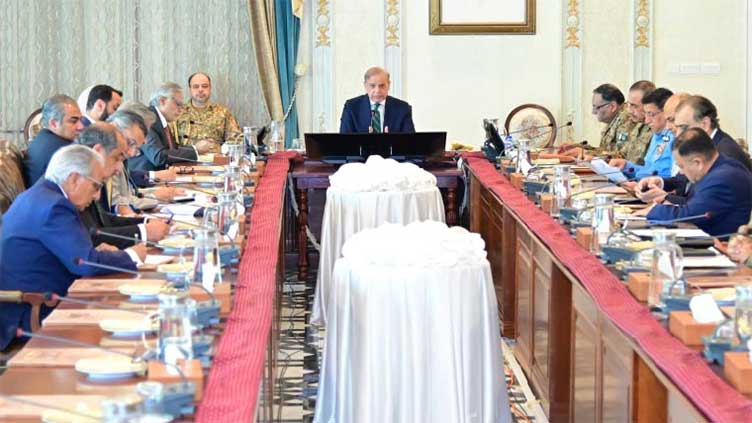
The National Security Committee meeting has started with Prime Minister Shehbaz Sharif in the chair to contemplate a suitable response to the actions taken by India following the Pahalgam attack.
Senior civil and military leadership is attending the meeting being held to deliberate upon internal and external situation.
Twenty-seven people were killed and 17 injured when suspected militants opened fire at tourists in India’s Jammu and Kashmir territory Pahalgam. This is said to be the worst such attack in the country in nearly two decades.
The ghastly incident triggered blame game between Pakistan and India, with both sides blaming each other of orchestrating the attack for ulterior motives.
Following a cabinet meeting chaired by Indian Prime Minister Narendra Modi on Wednesday, India announced the suspension of the Indus Waters Treaty with Pakistan, closure of Attari check post and other measures.
Later, Pakistan’s leaders decided to have a high-level meeting to be chaired by Prime Minister Shehbaz Sharif to come up with an effective response to India’s belligerence.
The meeting will discuss India’s irresponsible actions after what Pakistan calls Pahalgam’s false flag operation.
Senior civil and military leadership will deliberate upon internal and external situation, which has arisen after the Pahalgam incident. The top leaders will also take up India’s hasty and imprudent decision which is being equated with “water aggression”.
On Wednesday, Defence Minister Khawaja Asif said in a statement that a “session of the National Security Committee will be held under the chair of Prime Minister Shehbaz Sharif.”
He stated that decisions would be taken to give “an appropriate response to the Indian steps.”
In another statement, the defence minister said Pakistan condemned terrorism wherever it occurred in the world.
“India’s allegation against Pakistan after the Pahalgam incident is inappropriate,” Asif said at a private news channel. He added that Pakistan was the most affected country by terrorism and had been bearing the brunt of the menace for decades.
He questioned how Pakistan could resort to terrorism while being a victim to the scourge.
“There should be no ambiguity that we strongly condemn terrorism,” the defence minister said. He said the possibility of a “false flag operation” could not be ruled out.